
Yes. Field trials in Malaysia eliminated whole subterranean termite colonies with bait. In a 2000 study, Coptotermes curvignathus colonies stopped feeding 25 to 44 days after baiting started. In a 2009 study, all eight Asian subterranean termite colonies tested were eliminated in 42 to 77 days. Baiting works because workers carry the bait home and share it with the colony.
Does termite baiting work?
Yes. Malaysian field trials have eliminated whole subterranean termite colonies with bait, usually within one to three months. Termite bait is a food the termites prefer, laced with a slow-acting insect growth regulator. It stops termites from moulting properly. It works slowly on purpose: workers have time to carry the bait back to the nest and share it before they die, so it reaches the whole colony, queen included.
That matters in Malaysia because the main house termite, the Asian subterranean termite, lives in huge colonies. A Penang study found colonies of up to about 4 million termites, foraging up to 30 metres from the nest.
What did the Malaysian field trials find?
Two trials stand out, both run on real colonies in the field rather than in a lab.
| Study | Termite | Colonies | Result | Time to stop activity |
|---|---|---|---|---|
| Sajap, Amit and Welker (2000) | Coptotermes curvignathus | Field colonies, Malaysia | Foraging eliminated at all monitoring points | 25–44 days |
| Lee Leng, Mohd Shah and Sajap (2009) | Coptotermes gestroi | 8 | All 8 eliminated | 42–77 days (60 average) |
Sources: Journal of Economic Entomology 93(2): 429–433; Sociobiology 53(3): 891–901. Both used bait containing 0.5% hexaflumuron.
2000: the first Malaysian colony trial
Ahmad Said Sajap and colleagues first monitored C. curvignathus colonies for several months with wooden stakes buried in the ground. When termites attacked a stake, they replaced it with a bait station. The colonies:
- Stopped feeding at every monitoring point 25 to 44 days after baiting began.
- Ate about 27 to 79 g of bait each to get there.
The authors concluded that colonies could be monitored, baited and eliminated this way. C. curvignathus is a large Coptotermes species known in Malaysia as a pest of oil palm and other trees.
2009: eight Asian subterranean termite colonies
Choy Lee Leng, Zahriman Mohd Shah and Ahmad Said Sajap tested a hexaflumuron bait against field colonies of C. gestroi, the main house termite:
- All eight colonies were eliminated, in 42 to 77 days (60 days on average).
- Little bait was needed: each colony ate between about 23 g and 167 g, 60 g on average.
The trial also showed a reason to keep monitoring. Within two months, a colony of a different termite (Schedorhinotermes) moved into one of the cleared sites. It was baited too and eliminated after 59 days.
Why does baiting work better than spraying for these termites?
Spraying kills the termites it touches, but the colony and its queen are usually somewhere else. In the Penang colony study, each infested building was attacked by a single colony that could forage up to 30 metres away. A spray along a door frame cannot reach a nest under the garden or a neighbour's floor. Bait uses the colony's own workers to deliver the active ingredient to the nest.
Spraying still has its place, for example as a chemical barrier around a building. See baiting vs chemical treatment for when each one makes sense.
What does this look like on a real job?
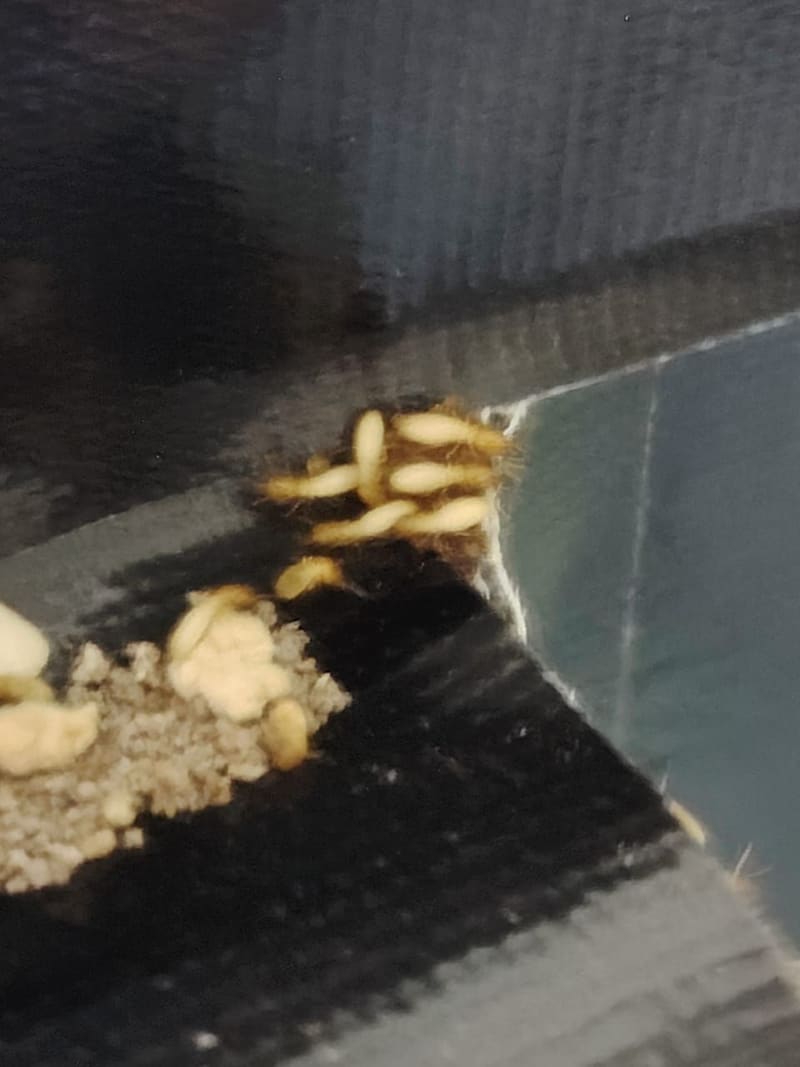
The same pattern: termites find the bait, feed, and activity fades over weeks. On our jobs we fix above-ground stations directly on active mud tubes or damaged timber, and put in-ground stations around the building. Then we come back on monitoring visits. Examples:
How long each stage takes is covered in how long termite baiting takes to work.
How much does termite baiting cost?
| Treatment | Price | Warranty |
|---|---|---|
| Termite baiting system (Sentricon®) | from RM899 | 5 years |
| Anti-termite chemical injection | from RM1950 | 5 years |
Source: R Termites price list, November 2026.
See the termite baiting system for how we install and monitor it. Send us a photo and your area on WhatsApp for a quotation.
Sources
- Sajap, A. S., Amit, S. and Welker, J. (2000). Evaluation of hexaflumuron for controlling the subterranean termite Coptotermes curvignathus (Isoptera: Rhinotermitidae) in Malaysia. Journal of Economic Entomology 93(2): 429–433. BioOne
- Lee Leng, C., Mohd Shah, Z. and Sajap, A. S. (2009). Elimination of subterranean termite colonies with hexaflumuron in an improved bait matrix, Preferred Textured Cellulose (PTC). Sociobiology 53(3): 891–901. UPM record
- Ab Majid, A. H. and Ahmad, A. H. (2015). Define colony number of subterranean termites Coptotermes gestroi (Isoptera: Rhinotermitidae) in selected infested structures. Sains Malaysiana 44(2): 211–216. UKM