
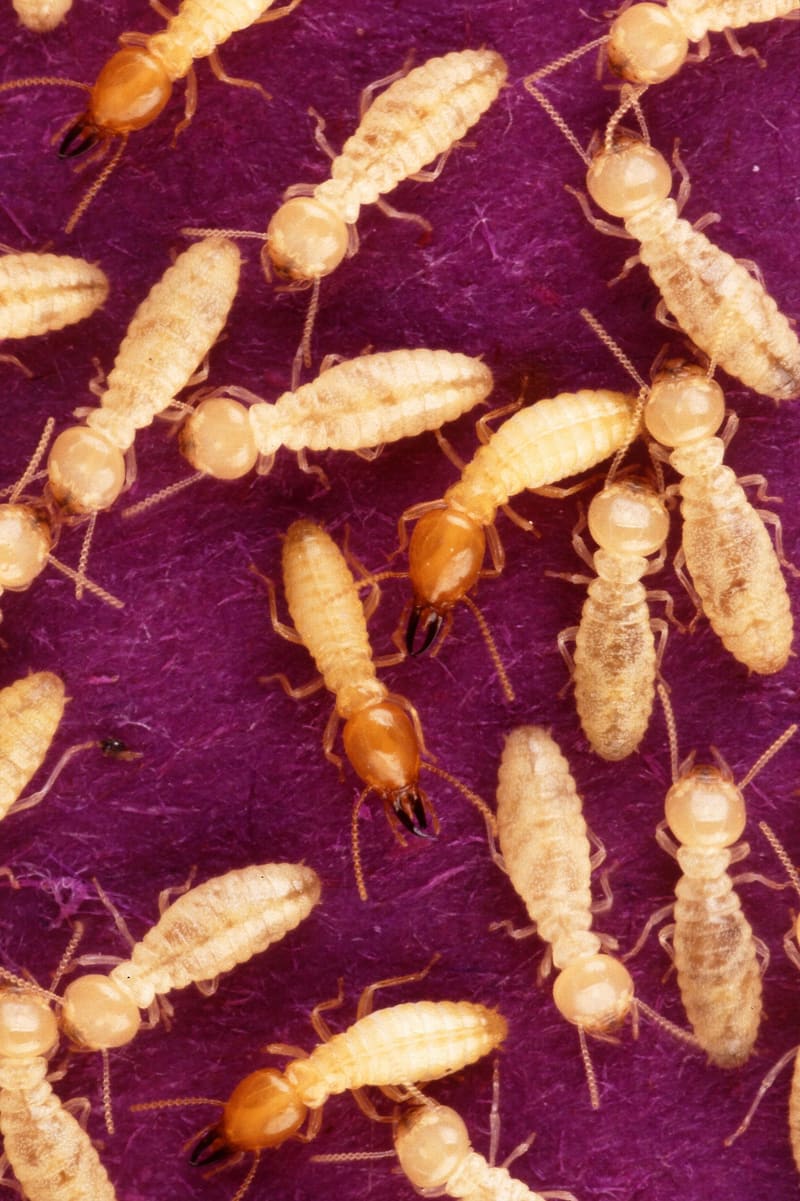
The Asian subterranean termite (Coptotermes gestroi) is the termite behind most of the damage to buildings in Peninsular Malaysia. Penang studies found that one colony can hold from about 100,000 to over 4 million termites and forage up to 30 metres away. It has also spread from Southeast Asia to the Caribbean, Hawaii, Florida and Fiji.
What is the Asian subterranean termite?
It is Coptotermes gestroi, the termite that causes most termite damage to buildings in Peninsular Malaysia. It was named in 1896. For decades Malaysian records also listed it as Coptotermes havilandi, until a 2003 study showed the two were the same species. The full story is in our history of termite research in Malaysia.
It is a subterranean termite: the colony nests in the soil and reaches timber through underground tunnels and mud tubes. The workers are pale and soft-bodied, which is why Malaysians call them "white ants". The soldiers have larger, darker heads and strong jaws for defending the colony. In parts of Asia it is known as the "Philippine milk termite".
Is it really the main termite in Malaysian homes?
Yes. Research in Penang and FRIM's taxonomy work both point to this one species.
- Penang: In 2005 USM researchers Goh and Lee collected Coptotermes termites around Penang Island and found four species. C. gestroi was the most common one attacking buildings. The other three made up less than 5% of the collection, all found outside buildings.
- FRIM: Entomologist L. G. Kirton wrote in 2005 that C. gestroi "is responsible for most of the damage to wood in buildings" in urban Peninsular Malaysia.
- The cost: Goh and Lee put the cost of controlling C. gestroi in Malaysian buildings and structures at more than RM30 million a year.
How big is one colony?
Far bigger than what you see. In 2015 Abdul Hafiz Ab Majid and Abu Hassan Ahmad of Universiti Sains Malaysia used a mark-recapture method on eight C. gestroi colonies attacking buildings in Penang. Researchers mark termites with a dye, release them and count the marked ones they catch again later. Their estimates:
| What they measured | Smallest colony | Largest colony |
|---|---|---|
| Foraging termites per colony | about 106,600 | about 4,185,000 |
| Foraging territory | 13 m² | 300 m² |
| Furthest foraging distance | 4 m | 30 m |
Source: Ab Majid and Ahmad (2015), Sains Malaysiana 44(2): 211–216. Eight colonies in Penang.
They also found that each building was attacked by a single colony. All the termites in your door frame, kitchen cabinet and ceiling are probably one family, with one nest that may be outside the house.
Why does colony size matter for treatment?
Killing the termites you can see barely dents a colony of hundreds of thousands, and the nest can be up to 30 metres away. That is why bait works well against this species: workers carry the bait back and share it through the colony. A termite baiting system targets the whole colony, not just the visible termites. Field trials in Malaysia have eliminated C. gestroi colonies this way. See what Malaysian baiting studies found.
Our Sentricon® termite baiting system starts from RM899 with a 5-year warranty. Send us a photo and your area on WhatsApp for a quotation.
When does it swarm?
All year round in Malaysia, with the biggest flights early in the year. Kok-Boon Neoh and Chow-Yang Lee of Universiti Sains Malaysia trapped flying C. gestroi termites with sticky traps for 12 months in Peninsular Malaysia. They found flights in every part of the year, with the largest swarms in the early months. Rain was not needed to trigger them, and flight activity was linked to air pressure and temperature. The University of Florida describes this species' swarms as happening at dusk or at night.
Flying termites (kelkatu) at your lights mean a mature colony is nearby. Read more in our guide to flying termites.
How did a Malaysian termite end up in Florida?
In timber and cargo carried by ships. The species is native to Southeast Asia, from northeast India through Myanmar and Thailand to Malaysia and Indonesia. Shipping has carried it much further:
| Year | Where it was found |
|---|---|
| 1937 | Barbados, then many other islands in the West Indies |
| 1963 | Hawaii (a single house) |
| 1996 | Miami, Florida (a church and a shop) |
| 1999 | Key West, Florida |
| 2009 | Fiji |
In Florida it now overlaps with the Formosan subterranean termite, and researchers have recorded the two species hybridising there.
Sources
- Goh, Y. P. and Lee, C. Y. (2005). Coptotermes identification and distribution in Penang Island, Malaysia. Proceedings of the 5th International Conference on Urban Pests. ICUP
- Kirton, L. G. (2005). The importance of accurate termite taxonomy in the broader perspective of termite management. Proceedings of the 5th International Conference on Urban Pests. ICUP
- Ab Majid, A. H. and Ahmad, A. H. (2015). Define colony number of subterranean termites Coptotermes gestroi (Isoptera: Rhinotermitidae) in selected infested structures. Sains Malaysiana 44(2): 211–216. UKM
- Neoh, K. B. and Lee, C. Y. Flight activity and flight phenology of the Asian subterranean termite, Coptotermes gestroi. PDF
- Kirton, L. G. and Brown, V. K. (2003). The taxonomic status of pest species of Coptotermes in Southeast Asia. Sociobiology 42(1): 43–63. University of Reading repository
- Su, N. Y., Scheffrahn, R. H. and Weissling, T. (1997). A new introduction of a subterranean termite, Coptotermes havilandi, in Miami, Florida. Florida Entomologist 80: 408–411.
- University of Florida IFAS, Featured Creatures: Asian subterranean termite. UF/IFAS
- Coptotermes gestroi, distribution summary. Wikipedia