
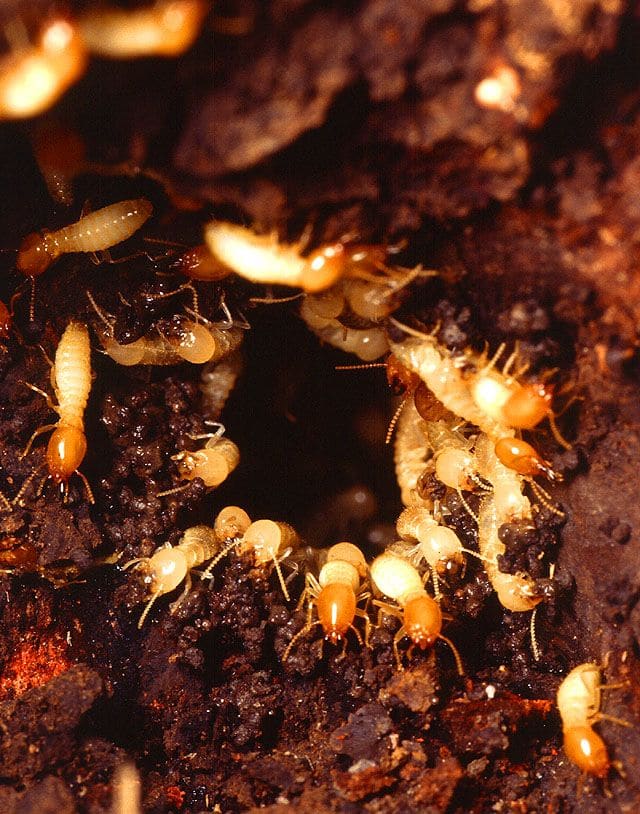
The termite queen is the egg-laying centre of a termite colony, and as long as she and the colony survive, termites keep coming back. Subterranean termites nest underground, often metres from the building they are eating, and connect to food through tunnels and mud tubes. That is why lasting treatment targets the colony and its queen, usually with bait the workers carry home, rather than spraying the termites you can see.
What does a termite queen do?
The queen lays the eggs that keep the colony growing. In many species she develops a hugely swollen abdomen and can live for many years. She is attended constantly by workers, who feed and groom her, and she shares a royal chamber with the king, who mates with her throughout her life.
Every worker eating your door frame, every soldier guarding a tunnel and every flying termite swarming at your window came from the colony she founded.
How does a termite colony work?
A colony is a family. Each caste has a job:
- Queen and king: reproduce. The colony grows around them.
- Workers: the vast majority. They forage for cellulose, build and repair tunnels, care for eggs and young, and feed every other member of the colony by sharing food mouth to mouth.
- Soldiers: defend the colony with large jaws or chemical sprays. They can't feed themselves and rely on workers.
- Alates (flying termites): future kings and queens that leave to start new colonies. See flying termites.
That food-sharing habit is the colony's weak point. Whatever the workers eat, they pass on to the rest of the colony, including the queen.
Where is the termite nest?
For subterranean termites, the main nest is usually in the soil, and it can be several metres from the damage. The colony reaches food through underground galleries and mud tubes, and may feed on several sources at once: your house, a neighbour's house, a tree stump and fence posts.
Some colonies also build satellite nests inside buildings, in wall cavities, under floors or in damp areas, where moisture lets them live away from the soil. Drywood termites, by contrast, live inside the timber they eat.
What about termite mounds (busut)?
Termite mounds are the visible above-ground part of some species' nests. In Malaysia you see them in plantations, open land and gardens. They are built from soil, saliva and droppings, with internal ventilation that keeps the nest humid and at a stable temperature.
A mound in your garden doesn't automatically mean termites are in your house: many mound-building species feed mainly on dead plant matter outdoors. But it does mean a large colony is active close by, and termites forage outward in all directions. It is worth an inspection, especially if the mound is near the building.
Why spraying termites doesn't kill the colony
Spray kills the workers it touches. But the workers in your door frame are a small fraction of the colony, and the queen keeps producing replacements. The colony also detects danger and simply abandons treated areas, finding another route in.
That's the cycle many Malaysian homeowners know well: spray, a few quiet months, then termites again in another room. Read more in how to get rid of termites.
How baiting reaches the queen
Baiting turns the colony's food-sharing against it. Workers find the bait, eat it and carry it back, sharing it with nestmates. The active ingredient in Sentricon® bait interrupts moulting, the process termites need to grow. Termites that can't moult die, the colony runs out of workers to feed the queen, soldiers and young, and it collapses.
This takes time, typically from a few weeks to a few months, because the bait has to spread through the colony before it works. But when it does, the source of the problem is gone. See how the Sentricon® termite baiting system is installed and monitored.
The bottom line
Termites are a colony problem, not a timber problem. Find where they are coming from, eliminate the colony, and keep monitoring so a new colony can't move in. For the full picture, see termites in Malaysia: the complete guide.