
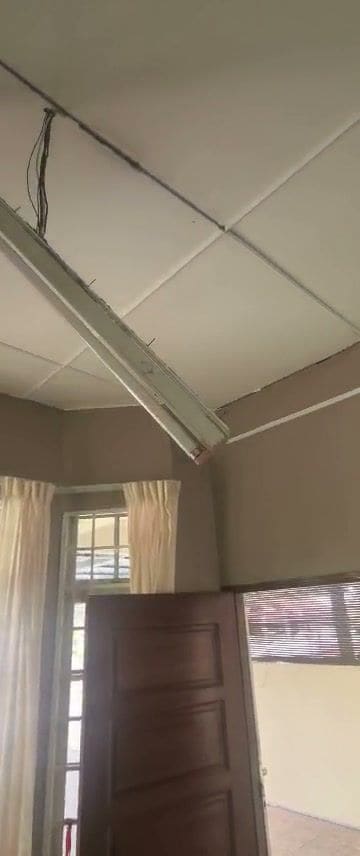
Mud tubes where the wall meets the ceiling, sagging or stained ceiling boards, soil falling from above, and light fittings or ceiling fans coming loose are the main signs of termites in the ceiling. Subterranean termites climb up inside walls to reach the timber that holds the ceiling up, and eat it from the inside until fittings lose their grip. On the job in the video below, a light fitting fell. Keep people away from loose fittings, don't pull down boards or spray, and have the ceiling inspected so bait stations can go on the active spots.
What termites in the ceiling look like: a real case
On this job, termites ate through the ceiling until a fluorescent light fitting fell and hung from its wires. The homeowner called once the fitting dropped. By then the timber it was screwed into had been eaten from the inside.
In the video, our technician fixes bait stations where the termites were active, at the corner where the wall meets the ceiling. That's where their mud tubes came up from inside the wall.
Signs of termites in the ceiling
Look up at the corners first: mud tubes where the wall meets the ceiling are the clearest sign. Other signs:
- Mud tubes coming out of cornices, ceiling joints, or around downlights and fan mountings
- Sagging, bowed or cracked ceiling boards, or boards with small holes packed with soil
- Stains or bubbling paint on the ceiling, which can look like a water leak
- Soil or fine debris falling onto furniture or the floor
- Light fittings, fans or curtain rails coming loose, or a fan that wobbles more than it used to
- Flying termites coming out of the ceiling or light fittings, often after rain
Termites eat the timber from the inside and leave the outside surface in place, so a ceiling can look normal until something gives way. See all 7 signs of termites.
How do termites get up there?
Subterranean termites come from the soil and climb. They come up through cracks in the floor slab, through wall cavities, and along pipes, conduits and wiring, building mud tubes to stay hidden and damp.
Above the ceiling they find timber: battens and joists holding the ceiling boards, roof trusses, and the paper facing on plasterboard. Older homes with timber ceilings and roofs have the most to lose, but houses with gypsum ceilings get termites too, because the roof timber is still above them.
Why termites in the ceiling are dangerous
- Things fall. Light fittings, ceiling fans and boards are screwed into timber. When termites hollow it out, the screws lose their grip.
- Electrical wiring runs through the ceiling, and a fitting hanging by its wires is a hazard.
- The roof structure can be weakened if termites reach the trusses.
- The colony keeps growing. Termites in the ceiling usually mean activity in the walls below too.
What to do if you find termites in the ceiling
- Keep people away from anything loose. Don't stand or let children play under a loose fitting or sagging board.
- Switch off a light or fan that looks loose, and don't use it until it has been checked and refitted.
- Don't pull down boards, scrape off mud tubes or spray. The termites in those tubes are the ones that will carry bait back to the colony.
- Take photos of what you see and send them to us on WhatsApp with your area.
How we treat termites in the ceiling
We find where termites are active and fix above-ground bait stations right on those spots, usually where mud tubes come up the wall or out of the ceiling, as in the video. Termites feeding there take the bait back to the colony, which dies off over the following weeks. See how long termite baiting takes.
The inspection also covers the walls below, the roof space where we can reach it, and the outside of the house, because the colony lives in the soil. In-ground stations around the building intercept termites heading in. Stations are checked on monitoring visits until activity stops.
Repair the ceiling and refit fittings once the termites are under control, so new boards and timber aren't eaten too.
Seen mud tubes on your ceiling or a fitting coming loose? Send us a photo on WhatsApp, and we'll arrange a free termite inspection. Learn more about our termite treatment.