
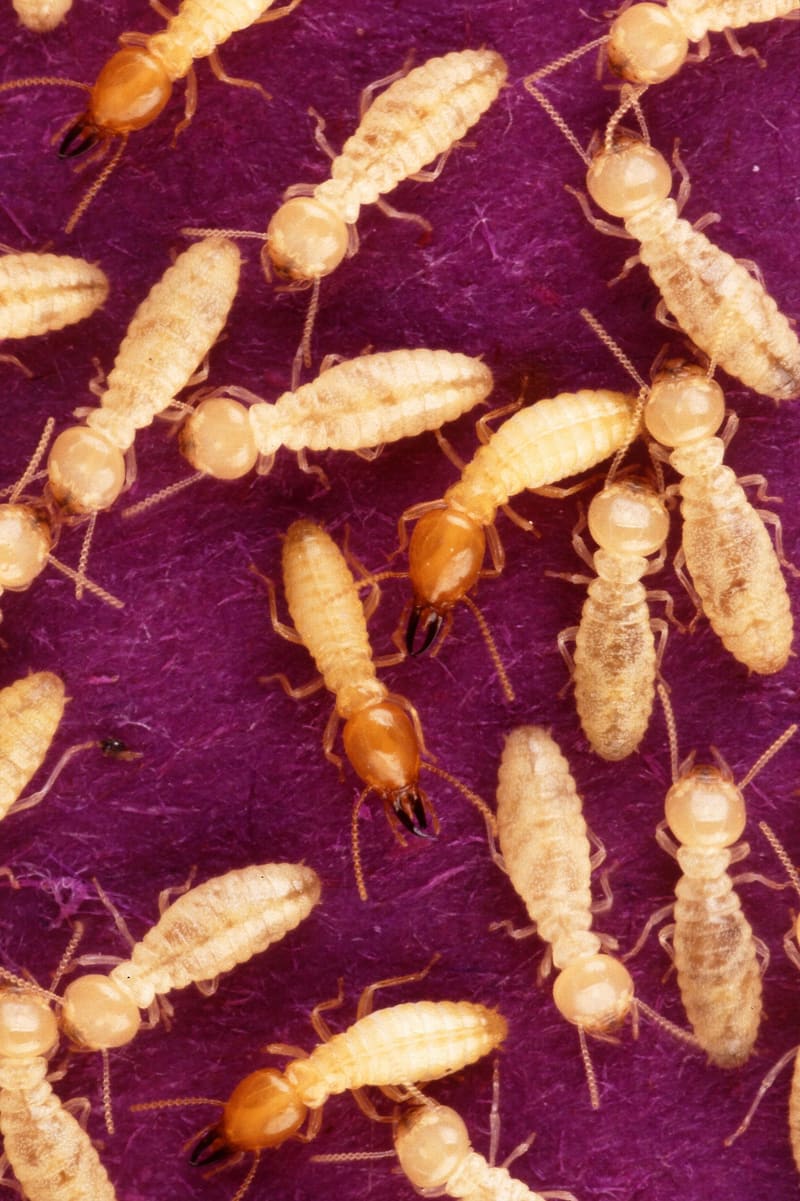
Yes, exploding termites are real, and one lives in Malaysia. Soldiers of Globitermes sulphureus, a yellow mound-building termite, can contract their bodies so hard that a gland bursts. The sticky yellow fluid traps ants and other attackers. A 1997 study showed the fluid comes from a modified gland with no opening, and that the defence is not always suicidal.
Are exploding termites real?
Yes. The best-known exploding termite is Globitermes sulphureus, a mound-building termite of Southeast Asia. The British naturalist G. D. Haviland described the species in 1898. Its soldiers have a yellow abdomen and large curved jaws. When the nest is attacked, some soldiers squeeze their bodies until a gland bursts and covers the attacker in sticky yellow fluid. Scientists call this autothysis, from the Greek for "self-sacrifice".
What did the 1997 study find?
The fluid comes from a sealed gland that only bursts open under violent pressure. Bordereau and colleagues studied G. sulphureus soldiers in Vietnam and published their results in Insectes Sociaux in 1997. They found:
- The gland: The defensive secretion comes from a greatly enlarged frontal gland with no opening to the outside, not from the salivary glands as earlier writers had assumed.
- The burst: Violent contractions of the abdominal wall rupture the gland and the body wall, releasing the fluid.
- Not always suicide: Soldiers first bite with their jaws, and the defence is not always fatal.
- The alarm call: An alarm pheromone calls more soldiers to the fight.
- The trap: The yellow fluid becomes sticky in air and can glue ants and other termites in place.
Earlier writers had called these soldiers "walking chemical bombs" and "kamikaze termites".
Is the exploding termite found in Malaysia?
Yes, it is recorded in Peninsular Malaysia, as well as Vietnam, Cambodia and Thailand. Malaysian scientists have studied it:
- 2003: Chow-Yang Lee and colleagues at Universiti Sains Malaysia mapped foraging colonies of G. sulphureus in Malaysia. They published the work in the Japanese Journal of Environmental Entomology and Zoology.
- 2007: Abdul Hafiz Ab Majid and colleagues ran a field trial in Penang testing control of the species with imidacloprid.
- Later: USM researchers, including Kok-Boon Neoh, tested a bistrifluron bait against field colonies.
Will exploding termites attack my house?
They can forage around homes, but they are not the main threat to Malaysian buildings. G. sulphureus builds earth mounds and is regarded as a pest in parts of Southeast Asia, especially of plantations and gardens. The termite behind most of the damage inside Malaysian houses is a different species, the Asian subterranean termite. It nests in the soil and attacks door frames, cabinets and roof timbers from out of sight.
If you see termites or a mound near your house, send us a photo on WhatsApp and we will take a look. See our termite treatment options and prices, and send us a photo and your area for a quotation.
Are there exploding ants too?
Yes. An ant from the same part of the world, Colobopsis saundersi, uses a similar defence: worker ants burst their bodies to release a sticky secretion against attackers. Termites and ants are only distantly related, so they evolved the trick separately. Termites are actually closer relatives of cockroaches than of ants; see termites vs ants.
Fun facts about termite soldiers
- Soldiers cannot feed themselves. In most termite species the soldiers' jaws are so specialised for fighting that workers have to feed them.
- Exploding is a last resort. In the 1997 study the first line of defence was biting, and not every soldier that fought died.
- A Malaysian fly targets soldiers. In Penang, scientists found a fly whose larvae grow inside the heads of termite soldiers. Read what's inside a termite mound.
Sources
- Bordereau, C., Robert, A., Van Tuyen, V. and Peppuy, A. (1997). Suicidal defensive behaviour by frontal gland dehiscence in Globitermes sulphureus Haviland soldiers (Isoptera). Insectes Sociaux 44: 289–297. Springer
- Lee, C. Y., Yap, J., Ngee, P. S. and Jaal, Z. (2003). Foraging colonies of a higher mound-building subterranean termite, Globitermes sulphureus (Haviland) in Malaysia. Japanese Journal of Environmental Entomology and Zoology 14(2): 105–112. J-STAGE
- Ab Majid, A. H. et al. (2007). Imidacloprid control trial against Globitermes sulphureus in Penang. Jurnal Biosains 18(2): 109–114 (paper title not reproduced here).
- Neoh, K. B. et al. Efficacy of bistrifluron against field colonies of Globitermes sulphureus. Pacific Rim Termite Research Group proceedings. PRTRG
- Haviland, G. D. (1898). Observations on termites; with descriptions of new species. Journal of the Linnean Society of London, Zoology 26: 358–442. BioStor record
- Globitermes sulphureus, species summary. Wikipedia