
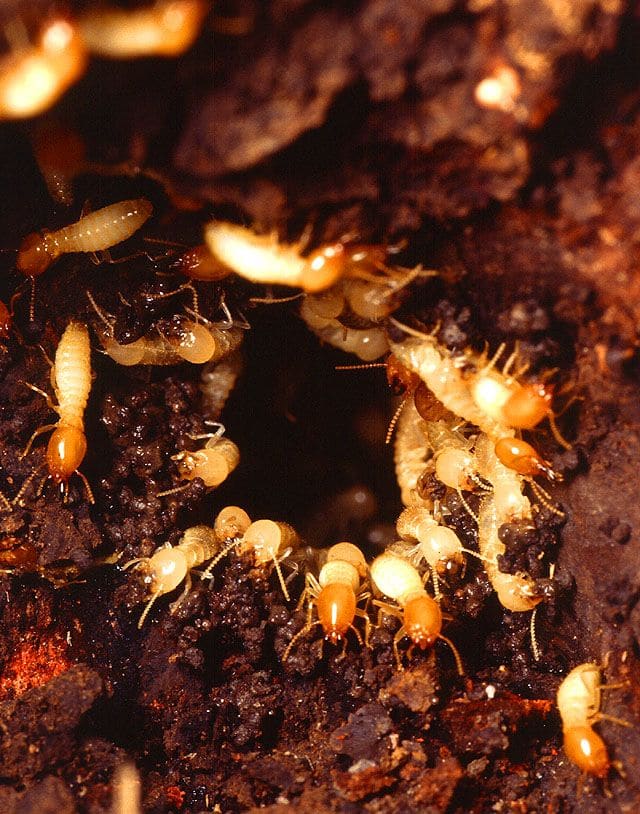
A termite mound (busut in Malay) is the above-ground nest of a mound-building termite colony. In a Penang study of Macrotermes gilvus, a common mound builder in Malaysia, small mounds held about 15,400 termites and large mounds about 61,400. More than 4 in 10 were larvae, not workers. Mound termites mostly feed outdoors, but a mound near your house shows termites are active close by.
What is a termite mound (busut)?
A termite mound is the above-ground part of a termite nest, built from soil the termites cement together. In Malay it is called a busut. Mounds keep the colony inside humid and protected, with chambers for the queen and king, the young and, in some species, gardens of fungus.
One of the most common mound builders in Malaysian gardens, parks and plantations is Macrotermes gilvus. It belongs to a group of termites that farm fungus inside the nest. The workers bring in plant material and the fungus helps break it down.
How many termites live in one mound?
Tens of thousands, and the number rises with the size of the mound. In 2012 Ching-Chen Lee, Kok-Boon Neoh and Chow-Yang Lee of Universiti Sains Malaysia dug up M. gilvus mounds on Penang Island and counted the termites inside.
| Mound size | Termites per mound (average) |
|---|---|
| Small | about 15,400 |
| Medium | about 33,500 |
| Large | about 61,400 |
Source: Lee, Neoh and Lee (2012), Annals of the Entomological Society of America 105(3): 427–433. Three mounds of each size, Penang Island.
The total population was linked to the mound's height and diameter, and to the weight of the queen.
Who lives inside: workers, soldiers or babies?
Mostly young termites and workers. The same study broke the population down by caste:
| Caste | Share of the colony |
|---|---|
| Larvae (young termites) | 42.60% |
| Workers | 42.19% |
| Soldiers | 14.16% |
| Presoldiers | 0.71% |
| Alates (future flying termites) | 0.34% |
Not every mound has one queen and one king. Of the 44 colonies they surveyed, 13.6% had more than one queen and 11.4% had more than one king. More about how the royal pair runs the colony in termite queen and nest.
The fly that grows inside a termite's head
USM researcher Kok-Boon Neoh found a new species of scuttle fly while digging up M. gilvus mounds on the university's Minden campus in Penang. Named Misotermes mindeni, it was described by Disney and Neoh in the journal Sociobiology in 2009.
- What it does: The fly's larva grows inside the head of a soldier termite. Infected soldiers have larger heads and smaller jaws than normal ones and die within several days.
- How common it is: A survey published in 2011 in the Journal of Economic Entomology checked 1,125 M. gilvus mounds in eight Malaysian states between September 2009 and January 2011. 12.4% had parasitised soldiers, all in Penang and Perak.
- Pest control: The researchers said more work is needed before the fly can be called an effective way to control termites.
Is a termite mound near my house a problem?
It means termites are active close by, but mound builders are not usually the ones eating houses. Macrotermes gilvus feeds mainly on plant matter outdoors. The termite behind most building damage in Malaysia is the Asian subterranean termite. It usually nests out of sight in the soil, and a single colony can forage up to 30 metres away.
What to do:
- Don't dig the mound out yourself. The queen sits in a royal chamber deep in the nest, often below ground level, so breaking the top open rarely reaches her.
- Check the timber near the mound: fences, door frames, garden furniture and tree stumps. Look for mud tubes and hollow-sounding wood.
- Termites in a tree? See termites in trees.
If you find termites in or near your house, see our termite treatment options and prices. Send us a photo and your area on WhatsApp for a quotation.
Sources
- Lee, C. C., Neoh, K. B. and Lee, C. Y. (2012). Caste composition and mound size of the subterranean termite Macrotermes gilvus (Isoptera: Termitidae: Macrotermitinae). Annals of the Entomological Society of America 105(3): 427–433. BioOne
- Disney, R. H. L. and Neoh, K. B. (2009). A new species of scuttle fly (Diptera: Phoridae) parasitizing a termite. Sociobiology 54. PDF
- Survey of Misotermes mindeni infestation in Macrotermes gilvus mounds in Malaysia (2011). Journal of Economic Entomology 104: 1675–1679. PubMed
- New fly offers hope for termite control (2009). SciDev.Net. SciDev.Net