
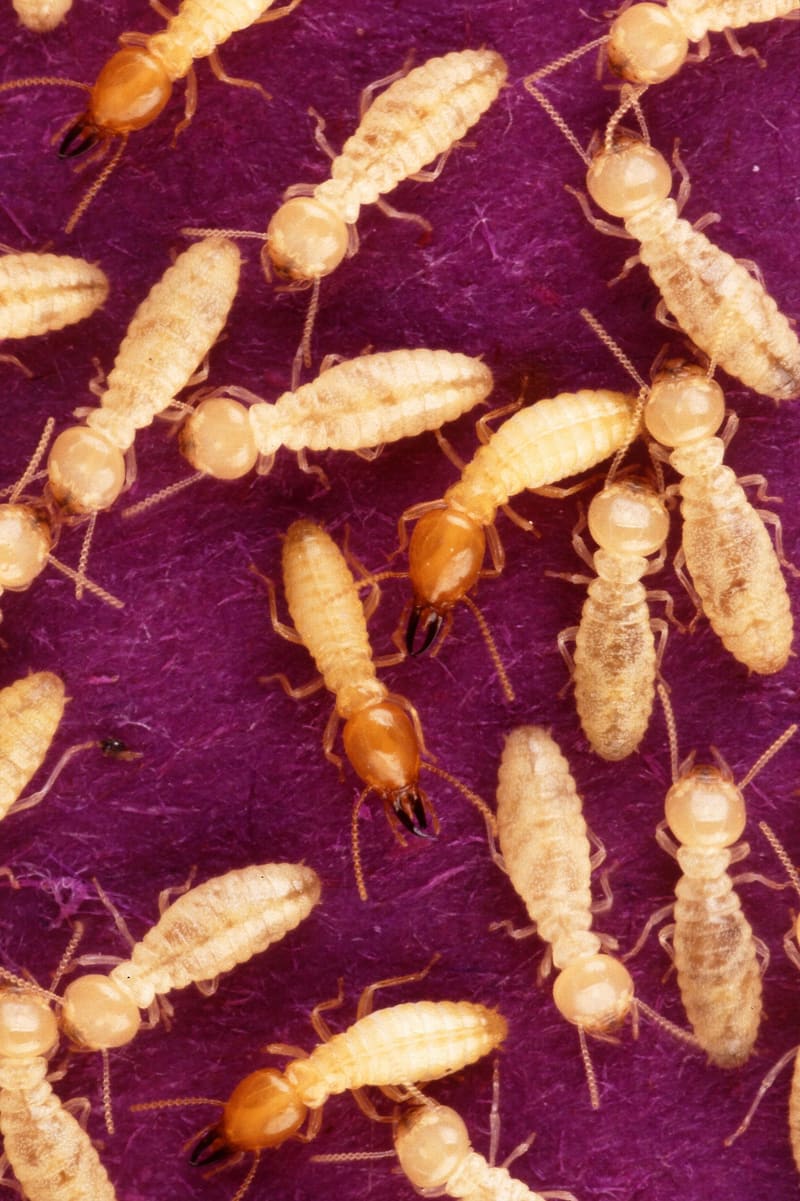
Termites evolved from cockroaches. DNA studies show that their closest living relative is a wood-eating cockroach called Cryptocercus, which digests wood with the same kind of gut microbes. Termite fossils go back to the Early Cretaceous, the age of the dinosaurs, more than 100 million years ago. Today about 2,900 living species are known worldwide, around 175 of them in Peninsular Malaysia.
Where did termites come from?
Termites are cockroaches that became social. The first clue was in their guts: in 1934 the American biologist L. R. Cleveland and his colleagues noticed that some termites and a wood-eating cockroach, Cryptocercus, carry the same kinds of single-celled gut organisms (protists) to help digest wood.
DNA confirmed it decades later:
- 2000: Nathan Lo and colleagues compared several genes across termites, cockroaches and mantises. Their analyses grouped termites with Cryptocercus, the wood-feeding cockroach, in a study published in Current Biology.
- 2007: Daegan Inward, George Beccaloni and Paul Eggleton of the Natural History Museum in London compared 107 species of termites, cockroaches and mantises. Termites sat inside the cockroach family tree. Their paper in Biology Letters was titled "Death of an order", because it argued termites should no longer be classed as a separate order of insects.
Not every scientist agreed with renaming the order, and the debate over names went on in the same journal. The relationship itself, termites as close cousins of wood-eating cockroaches, is now well supported.
Why are termites called "white ants"?
Because they look and live a bit like ants, and the workers are pale. Workers are about ant-sized, live in large colonies and travel in lines, which is why they are so widely called white ants. The workers spend their whole lives inside soil, wood and mud tubes, out of the light, and are soft and pale.
The names stuck across Malaysia: anai-anai in Malay, 白蚁 (literally "white ant") in Chinese, and "white ants" in everyday Malaysian English. Our complete guide to termites in Malaysia covers the local names and the signs to look for.
How old are termites?
More than 100 million years old. Termite fossils are known from the Early Cretaceous, when dinosaurs were still alive. Examples include termites preserved at Las Hoyas and Montsec in Spain and in the Crato Formation of Brazil.
A 2009 study by Michael Engel, David Grimaldi and Kumar Krishna, published by the American Museum of Natural History, built the first family tree of termites that included fossils. It found that:
- Some modern termite families already existed in the Cretaceous.
- The "higher termites" (family Termitidae) came later. They diversified after the Cretaceous, in the Tertiary period, and today make up about 84% of all termite species.
In Malaysia, the mound builders Macrotermes and the "exploding" Globitermes are higher termites. The main house termite, Coptotermes gestroi, belongs to an older family, the Rhinotermitidae. Read about it in the Asian subterranean termite.
How many kinds of termites are there?
About 2,900 living species worldwide. The Treatise on the Isoptera of the World (Krishna and colleagues, 2013) listed 3,106 species: 2,933 living and 173 known only as fossils.
Peninsular Malaysia alone has about 175 recorded species, according to Termites of Peninsular Malaysia (Tho Yow Pong, FRIM, 1992). Only a handful damage buildings. The story of how scientists worked that out is in our history of termite research in Malaysia.
| Fact | Figure | Source |
|---|---|---|
| Closest living relative | Cryptocercus, a wood-eating cockroach | Lo et al. 2000; Inward et al. 2007 |
| Oldest fossils | Early Cretaceous, over 100 million years | Engel, Grimaldi & Krishna 2009 |
| Living species worldwide | about 2,933 | Krishna et al. 2013 |
| Species in Peninsular Malaysia | about 175 | Tho 1992 |
| Share that are "higher termites" | about 84% | Engel, Grimaldi & Krishna 2009 |
What does this mean for your house?
Termites are an ancient, very successful group, and Malaysia's warm, humid climate suits them. They have spent more than 100 million years living hidden in soil and wood and feeding on dead plant material. To a subterranean termite colony, a door frame or kitchen cabinet is more of the same.
That is why stopping them usually means dealing with the colony, not the few termites you can see. Our termite treatment uses Sentricon® baiting, which the workers carry back to the nest. Whole-house baiting starts from RM899 with a 5-year warranty. Send us a photo and your area on WhatsApp for a quotation.
Five quick facts
- Termites and cockroaches share gut microbes that help them digest wood. That was the first clue to their family link, spotted in 1934.
- A 2007 paper declared the "death of an order", arguing termites should be classified within the cockroaches.
- Termites lived alongside dinosaurs. Their fossils date to the Early Cretaceous.
- Most termite species are "higher termites", about 84%. Many of them farm fungus or eat soil rather than wood.
- Malaysia's main house termite is from an older family than its mound-building neighbours.
Sources
- Inward, D., Beccaloni, G. and Eggleton, P. (2007). Death of an order: a comprehensive molecular phylogenetic study confirms that termites are eusocial cockroaches. Biology Letters 3: 331–335. PMC
- Lo, N. et al. (2000). Evidence from multiple gene sequences indicates that termites evolved from wood-feeding cockroaches. Current Biology.
- Engel, M. S., Grimaldi, D. A. and Krishna, K. (2009). Termites (Isoptera): their phylogeny, classification, and rise to ecological dominance. American Museum Novitates 3650. BioOne
- Krishna, K. et al. (2013). Treatise on the Isoptera of the World. Bulletin of the American Museum of Natural History 377. AMNH Digital Library
- Tho, Y. P. (1992). Termites of Peninsular Malaysia. Malayan Forest Records No. 36, Forest Research Institute Malaysia. FRIM
- "Face it: Termites are roaches". Science News. Science News